TrueMotion's Advanced 3D Pose Estimation Sets a New Standard for Musculoskeletal Care
May 1, 2025
New benchmark analysis shows Hinge Health’s technology significantly leads in accuracy against Apple's Vision 3D pose estimator and Google's MediaPipe pose landmark detector
By The Hinge Health Computer Vision Team
At Hinge Health, we’re helping people move beyond pain by delivering personalized and frictionless musculoskeletal care. A cornerstone of this work is our cutting-edge computer vision technology, TrueMotion®, designed to seamlessly guide our members through their exercise therapy programs.
Unlike other computer vision products that are tailored to controlled environments, we’ve built TrueMotion from the ground up to function robustly in real-world conditions — accommodating a wide range of body types, room lighting, clothing, and movement patterns with no need for specialized hardware. TrueMotion works on the smartphones our members already have in their pockets, seamlessly integrating it into their daily routines.
When a Hinge Health member begins an exercise session, TrueMotion activates using the phone's built-in camera to deliver real-time, 3D movement analysis. Members receive feedback on their form — for example, suggestions to straighten a knee or slow down a motion — without ever needing to configure settings or wear sensors. By automatically counting repetitions and staying responsive to body movement, TrueMotion keeps exercise therapy engaging.
The Importance of Accurate 3D Pose Estimation
For TrueMotion to deliver precise guidance, accurately estimating human body landmarks (or "key-points") in three dimensions is paramount. While many traditional systems rely on simpler 2D pose estimations, these approaches are particularly susceptible to inaccuracies stemming from camera positioning or a person’s orientation relative to the camera. Such discrepancies significantly degrade the quality of feedback, compromising the essential purpose of guided exercise therapy.
We’ve focused significant research and development in building a robust 3D human pose estimation approach that can accurately infer landmark positions for any body type, performing any pose, wearing any clothing, in any room environment.
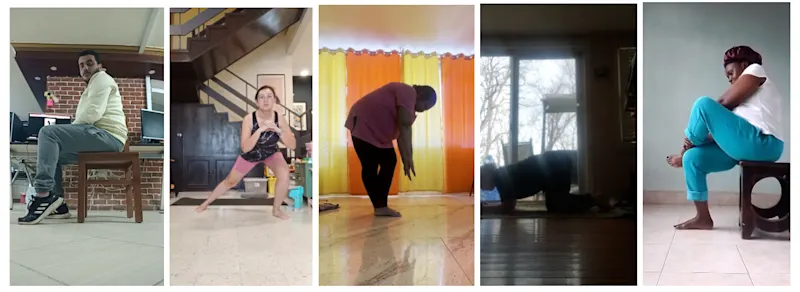
We've built this state-of-the-art technology to operate effectively on nearly any consumer phone or device rather than requiring specialized, high-cost equipment. This deliberate choice reduces barriers to adoption, enables users to incorporate Hinge Health seamlessly into their daily lives, and substantially lowers care costs, facilitating broader access to high-quality musculoskeletal care.
Benchmarking TrueMotion against Industry Alternatives
To objectively assess the accuracy and reliability of TrueMotion, we've evaluated our technology’s 3D pose estimator against leading alternatives in the industry, specifically Apple's Vision 3D pose estimator and Google's MediaPipe pose landmark detector.
We conducted this analysis on a specialized Exercise Therapy Motion Capture test dataset, captured within a professional Optitrack motion-capture studio tailored toward musculoskeletal exercises frequently encountered in our programs. Key details of this dataset include:
5 participants, representing different body types and proportions
34 distinct musculoskeletal-focused exercises
83 minutes of recorded movements total, across 150,210 frames
Captured with an Optitrack IR motion tracking system and simultaneously from 5 separate mobile devices per session (both Android and iOS)
Importantly, while this dataset remains internal, it was expressly excluded from any training or validation phase to accurately represent real-world performance on unseen, challenging musculoskeletal exercises. We compared our TrueMotion estimator (late 2024), Apple Vision (Q3 2024), and Google MediaPipe Lite (Q2 2024). Here's a brief overview of these models (with key-points referring to the number of positions tracked on the body):
TrueMotion: 37 key-points tracked, 47 FPS on Pixel 3
Apple Vision: 17 key-points tracked, 50 FPS on iPhone 11
Google MediaPipe Lite: 33 key-points tracked, 49 FPS on Pixel 3
Comparing Accuracy and Reliability
We assessed performance of each model using industry-standard metrics for 3D pose estimation accuracy and stability:
3D Percent Correct Keypoints Area Under Curve (3D PCK AUC): Evaluates how accurately the model is measuring the position of each joint
Mean Per-Joint Angle Error (MPJAE): Evaluates how accurately the model is measuring the angles of each joint in relation to each other
Acceleration Error: Evaluates how accurately the model measures the speed and movement of each joint
Missed Frame %: Evaluates how accurately the model detects a person in the frame
Test Results
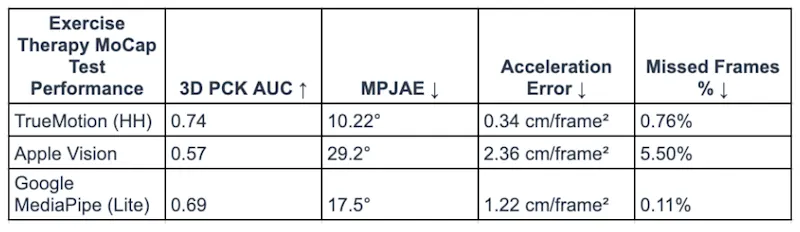
As seen clearly from these results, TrueMotion leads significantly in overall accuracy (3D PCK AUC), per-joint angle accuracy (MPJAE), and temporal stability (Acceleration Error) over the other offerings. Ultimately, this means that computer vision-driven products and experiences built on TrueMotion provide more accurate insights and guidance cues to users.
While Google MediaPipe Lite demonstrated a lower missed frame percentage (0.11%), qualitative inspection revealed significantly more false positive detections (e.g., identifying persons in static objects such as coat racks). TrueMotion, with a missed frame rate already below 1%, offers an optimal balance of precision, reliability, and usability. Heavier implementations of MediaPipe (e.g., MediaPipe Heavy model running at 19 FPS) were also tested, yet none surpassed TrueMotion's accuracy metrics.
Putting It All Together
Accurate pose estimation is more than just placing dots on a skeleton — it’s about turning movement into meaningful, real-time therapeutic insights. Every time a Hinge Health member opens their phone to begin a session, TrueMotion delivers intelligent, depth-aware guidance that adapts to their unique body, environment, and movement pattern — ensuring every rep counts. This technology helps members perform exercises safely and correctly, deepening engagement, boosting confidence, and driving better long-term outcomes.
We believe that world-class musculoskeletal care shouldn’t demand specialist equipment or clinical settings — it should meet people where they are. We aim to build the future of digital MSK care, one confident movement at a time.