
Hinge Health's 2025 State of Musculoskeletal Care Report reveals how digital solutions are preventing avoidable surgeries and more.
Better care early in someone’s pain journey helps them recover through movement and lifestyle changes, while avoiding unnecessary and costly interventions like imaging or surgery.
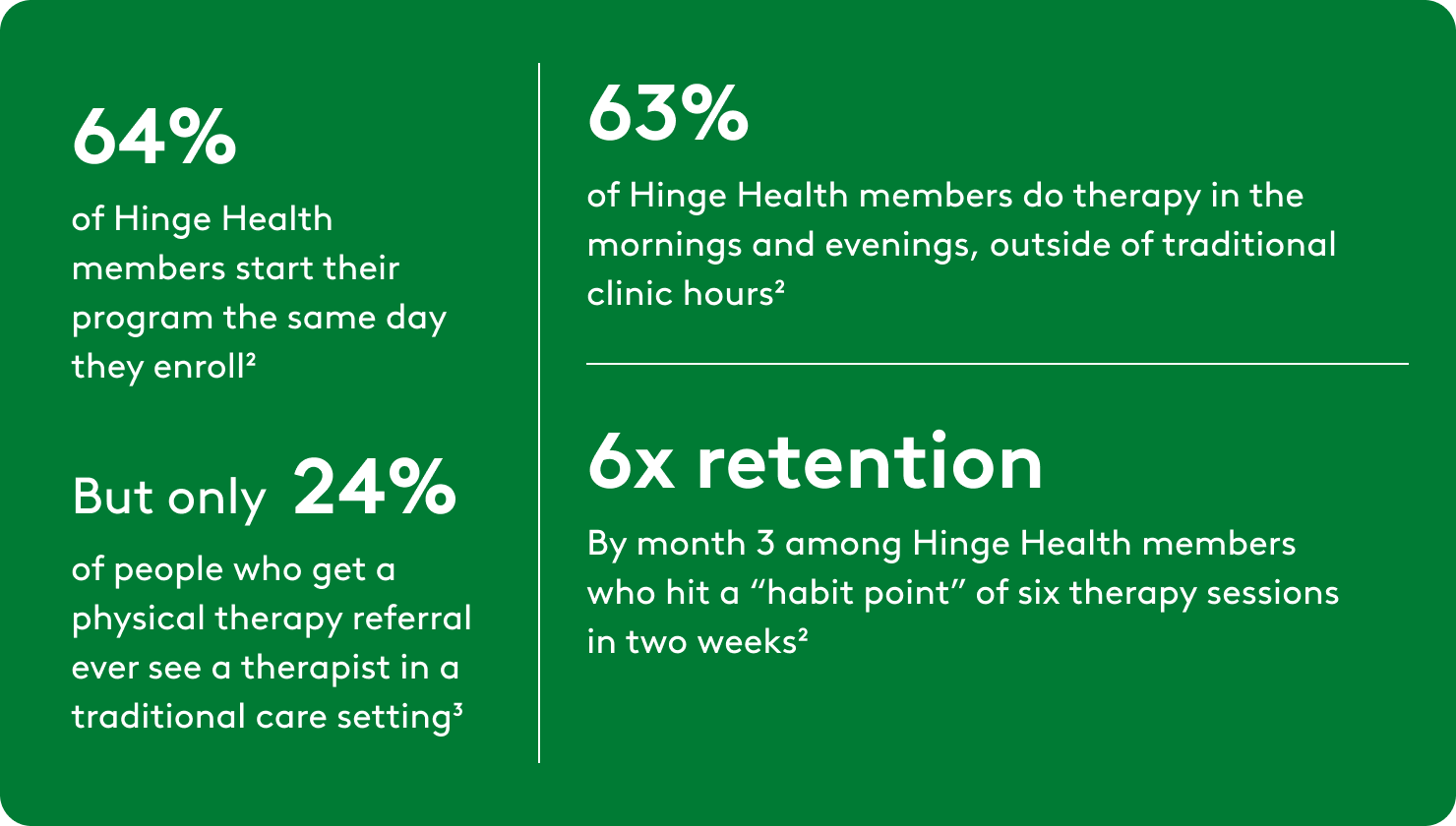
Digital MSK solutions like Hinge Health make this conservative treatment convenient and engaging. It starts with technology that can enable fast, easy access to treatment. Hinge Health members can start their personalized exercise program immediately after joining. On-demand sessions let members choose when and where to do exercise therapy (most opt for times outside of traditional clinic hours).
To achieve outcomes with conservative care, people must stick with treatment. While adherence to traditional physical therapy is low,¹ Hinge Health focuses on habit formation. Our research shows that people who reach a “habit point” (six therapy sessions in two weeks) are much more likely to stay consistent in their program.²
How does digital care reduce healthcare utilization?
When people do exercise therapy regularly and work with a care team for holistic pain relief, it leads to a proven reduction in surgery and opioid prescriptions compared to people who receive traditional PT care.
Here are 3 key factors that work:

Our analysis of health claims data shows that about 6% of people drive 85% of MSK costs.⁴ Our AI-driven database identifies high-risk members to educate on conservative treatment.
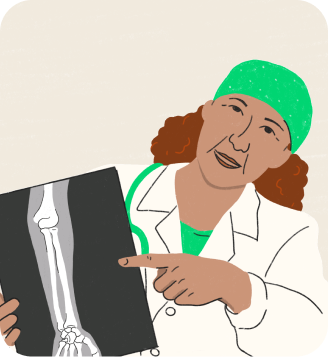
Many choose surgery due to limited awareness of or access to other options, but 74% of Hinge Health members choose less-invasive, lower-cost options when they engage with our orthopedic specialists.⁵

A holistic program with physical therapists and health coaches builds confidence in nonsurgical care, and adherence is often higher than in traditional care.⁶ ⁷
Untitled
Fewer spinal fusion surgeries⁸
Reduction in hip replacements⁹
Reduction in knee replacements⁹
Download the 2025 State of MSK Care Report
- 1Essery R, Geraghty AW, Kirby S, et al. Predictors of adherence to home-based physical therapies: A systematic review. Disabil Rehabil. 2016;39(6):519–534.
- 2Hinge Health. Internal analysis. 2024.
- 3Sharpe JA, Martin BI, Fritz JM, et al. Identifying patients who access musculoskeletal physical therapy: A retrospective cohort analysis. Fam Pract. 2020;38(3):203–209.
- 4Hinge Health. Internal analysis of 2023 medical claims data.
- 5Hinge Health. Internal analysis. 2022.
- 6Bennell KL, Marshall CJ, Dobson F, et al. Does a web-based exercise programming system improve home exercise adherence for people with musculoskeletal conditions? Am J Phys Med Rehabil. 2019;98(10):850–858.
- 7Lambert TE, Harvey LA, Avdalis C, et al. An app with remote support achieves better adherence to home exercise programs than paper handouts in people with musculoskeletal conditions: A randomised trial. J Physiother. 2017;63(3):161–167.
- 8Yadav S, Gold LS, Zaidi QH, et al. Spinal fusion surgery use among adults with low back pain enrolled in a digital musculoskeletal program: An observational study. BMC Musculoskelet Disord. 2024;25(1).
- 9Lu L, Gold L, Koenig KM, et al. Digital musculoskeletal program is associated with decreased joint replacement rates. Am J Manag Care. 2023;30(4).